

Roundabouts Move In What Direction
Acquire about roundabouts, including how to travel through them as a pedestrian, cyclist or driver.
What is a roundabout?
A modern roundabout is a circular intersection where drivers travel counterclockwise around a center island. At that place are not traffic signals or stop signs in a modern roundabout. Drivers inbound the roundabout yield to traffic already in the roundabout, and so enter the circulating roadway and exit at their desired street, then they part differently from older circular intersection types.
Studies by the Federal Highway Administration (FHWA) accept establish that roundabouts tin can increment traffic capacity by 30 to 50 pct compared to traditional intersections.
Types of circular intersections
In that location are more than round intersections than simply roundabouts, and many differences between each type.
Traffic circles
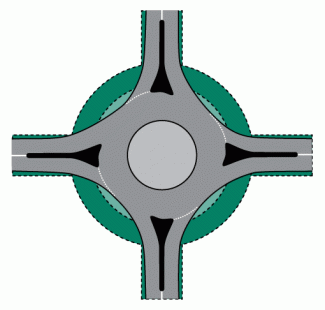
Traffic circles, or rotaries, are much larger than modern roundabouts. In the graphic above, a traffic circumvolve is shown in greenish, with a modernistic roundabout overlay shown in grey. Traffic circles often have stop signs or traffic signals where branches meet the circle. The Arc de Triomphe in Paris and Dupont Circle in Washington, DC, are examples of traffic circles.
Drivers enter the circle at a right bending like a typical perpendicular intersection and may not take to yield to traffic already in the circle. Traffic circles typically go congested if many vehicles enter at the aforementioned time.
Neighborhood traffic calming circles
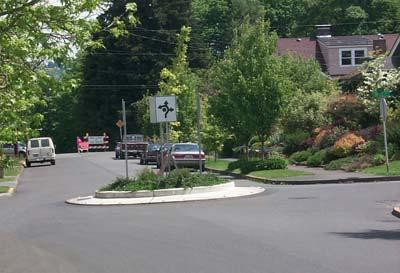
Neighborhood traffic calming circles are much smaller than modern roundabouts and often supercede stop signs at four way intersections. They are typically used in residential neighborhoods to slow traffic speeds and reduce accidents, only by and large are non designed to accommodate larger vehicles. Many drivers oft plow left in front end of the circles, rather than turning around them as would be correct.
Modern roundabouts
Mod roundabouts are designed to suit vehicles of all sizes, including emergency vehicles, buses, and truck and trailer combinations. In a modern roundabout, drivers enter the intersection by navigating a gentle curve. Drivers yield at entry to traffic already in the roundabout, then proceed into the intersection and go out at their desired street.
A main characteristic of the modern roundabout is a raised primal isle. The circular shape is designed to command the direction of traffic and reduce speeds to 15 to xx mph. It also reduces the likelihood of t-os (right angle) or caput-on collisions.
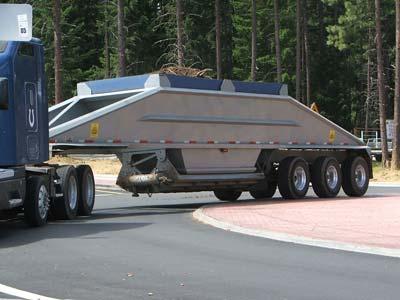
The central island of many roundabouts includes a truck apron (above), a raised section of concrete that acts as an extra lane for large vehicles. The back wheels of the oversize vehicle can ride upward on the truck apron so the truck can easily complete the turn, while the raised portion of concrete discourages utilise by smaller vehicles.
In improver to the key island, roundabouts as well feature triangular splitter islands designed to tiresome and direct traffic. The islands also provide a refuge for pedestrians. This means pedestrians can choose to cantankerous 1 management of traffic at a time and have a safe place to wait before crossing another management of traffic.
Roundabout nuts
Roundabouts are designed to brand intersections safer and more efficient for drivers, pedestrians, and cyclists. At that place are 2 basic types of roundabouts: unmarried-lane and multi-lane.
There are a few key things to recall about driving through roundabouts:
- Yield to drivers in already in the roundabout (on the circulating roadway)
- Stay in your lane; do not change lanes
- Practice not terminate in the roundabout
- Avert driving next to oversize vehicles
Want to larn more? Nosotros have a video available online:
- How to bulldoze a roundabout - YouTube
Y'all can also download our Rules of the Roundabout brochure in English language and Castilian:
- Rules of the Roundabout (PDF 408KB)
- Español - Reglas de la Rotonda (PDF 379KB)
Pedestrians and bicycles in roundabouts
Modernistic roundabouts are designed to exist safer than traditional intersections for people walking or using mobility assistance devices. Vehicles are moving at a slower charge per unit of speed in roundabouts - typically xv to 20 miles per hr (MPH).
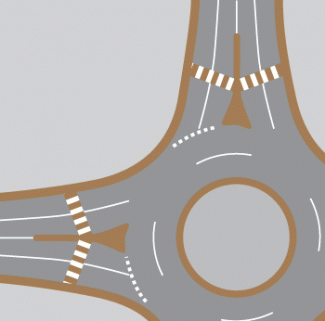
Crosswalks (shown to a higher place in brownish and white) are set farther back from vehicle traffic, allowing more time for drivers to react to people in the roadway earlier merging into or exiting the roundabout. Triangular islands between lanes of vehicle traffic provide pedestrians moving through the roundabout a safe place to wait if they choose to cantankerous just one direction of traffic at a time.
People using the crosswalk should await for budgeted vehicle traffic, then move through the crosswalk to the triangular island. Before continuing, they should expect for traffic entering or exiting the roundabout. When it is safe, they tin can go along through the crosswalk.
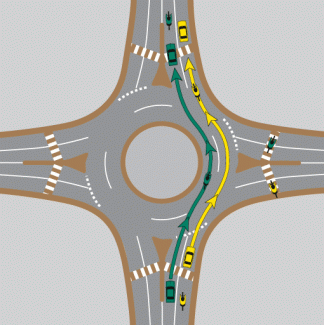
Bicyclists tin cull to ride through the roundabout with traffic or walk their bicycles through the pedestrian crosswalks similar to a traditional intersection. Similar people driving, bicyclists must obey the rules of the roundabout as they go along through the intersection. Riders who choose to walk their bicycles may find that some roundabout designs have a ramp onto the sidewalk, making it easier for bicycles to transition from the roadway to the sidewalk.
Want to learn more than? Watch a video nigh using a roundabout as a driver, pedestrian or bicyclist.
How to drive through a roundabout
How to drive through a roundabout depends on whether the roundabout is a single lane or multi-lane roundabout.
Driving single-lane roundabouts
When approaching a roundabout, there should exist a yellow "roundabout ahead" warning sign with an advisory speed limit for the roundabout.
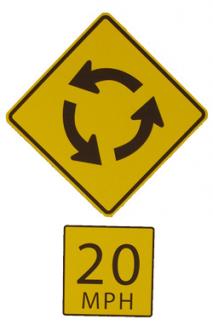
Slow downwardly as you approach the roundabout, and scout for pedestrians in the crosswalk. Continue towards the roundabout and look to your left every bit y'all near the yield sign and dashed yield line at the entrance to the circulating roadway. Yield to traffic already in the circulating roadway. If in that location is no traffic in the roundabout, you may enter without yielding.
One time you lot run across a gap in traffic, enter the circle and proceed to your exit. Brand sure to stay in your lane as you navigate the roundabout, and look for pedestrians and use your turn indicate before yous leave.
Watch a video nearly driving through a roundabout.
Driving multi-lane roundabouts
In a multi-lane roundabout, you will run into two signs as you approach the intersection: the same yellow "roundabout ahead" warning sign and speed signs used for unmarried-lane roundabouts, and a blackness and white "lane choice" sign. This 2d sign is to help y'all choose the advisable lane for the direction you want to go out the roundabout.
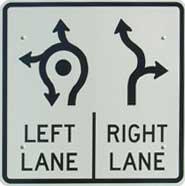
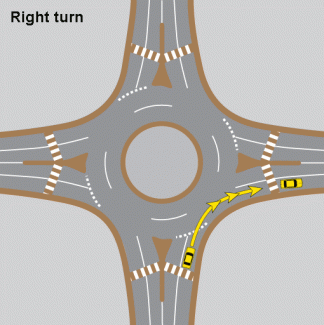
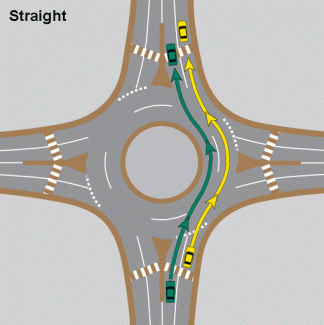
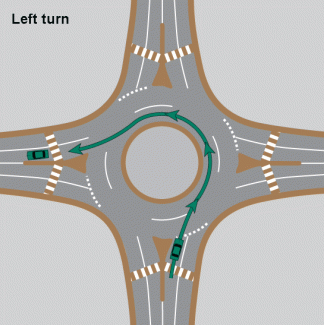
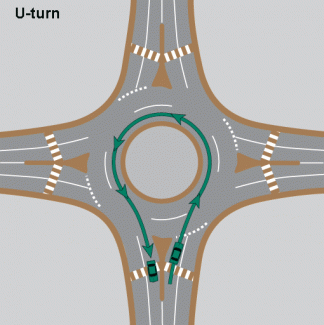
You choose your lane in a multi-lane roundabout the same way you would in a traditional multi-lane intersection. Mostly, to go directly or plough right, you would use the right lane. To get straight or turn left, you would use the left lane. Usually you tin also make a U-turn from the left lane too.
The graphics below show which turns can exist made from each lane in a typical multi-lane roundabout. Arrows in xanthous show movements that can be made from the right lane, and arrows in green testify movements that can be made from the left lane.
Right plow
Straight
Left turn
U-turn
After selecting the appropriate lane, watch for pedestrians in the crosswalk as yous approach the roundabout. At the dashed yield line, expect to your left and yield to drivers already in the roundabout. Information technology is of import to call back that in a multi-lane roundabout, entering traffic must yield to both lanes of the circulating roadway. If there is no traffic in the roundabout, y'all may enter without yielding.
When there is a gap in traffic, merge into the roundabout in the correct lane and proceed to your get out. Look for pedestrians and utilize your plow betoken before exiting the roundabout.
Scout a video on how to bulldoze through a roundabout.
Trucks, oversize vehicles, and vehicles with trailers in roundabouts
Roundabouts are designed to accommodate vehicles of all sizes, including emergency vehicles, buses, farm equipment, and semi-trucks with trailers.
Depending on the size and blazon of the roadway, the vehicle and/or its trailer may employ specially designed truck aprons - raised sections of pavement around the central island that acts equally a temporary lane for large vehicles. The back wheels of the large vehicle can ride upward onto the frock due to its rolled curb, allowing the rear of the vehicle or trailer to off-runway and successfully complete the turn. The truck apron is raised, and often a different color or material than the roadway, to discourage utilise past smaller vehicles and emphasize that information technology is not a normal travel lane.
In multi-lane roundabouts, large vehicles may straddle both lanes to make their plough. Because the rear of the vehicle or trailer is likely to off-track into the other lane while making a turn, other drivers should never bulldoze next to big vehicles in a roundabout.
Benefits of roundabouts
Roundabouts have many important benefits over other intersection control types.
Improve safe
Studies have shown that roundabouts are safer than traditional stop sign or traffic signal controlled intersections.
Roundabouts reduced injury crashes by 75 percentage at intersections where stop signs or traffic signals were previously used for traffic control, according to a study by the Insurance Institute for Highway Safety (IIHS). Studies by the IIHS and Federal Highway Assistants (FHWA) have shown that roundabouts typically achieve:
- A 37 percent reduction in overall collisions
- A 75 percent reduction in injury collisions
- A ninety percent reduction in fatality collisions
- A xl per centum reduction in pedestrian collisions
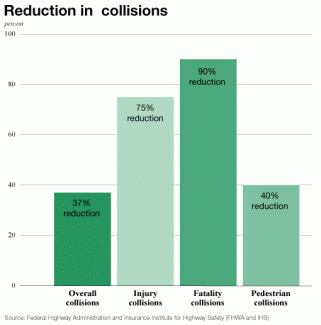
In that location are several reasons why roundabouts aid reduce the likelihood and severity of collisions:
- Depression travel speeds. Drivers must slow down and yield to traffic before inbound a roundabout. Speeds in the roundabout are typically betwixt xv and 20 miles per hour. The few collisions that occur in roundabouts are typically small and cause few injuries since they are at such low speeds.
- No calorie-free to trounce. Roundabouts are designed to promote a continuous, circular flow of traffic. Drivers demand just yield to traffic earlier entering a roundabout; if there is no traffic in the roundabout, drivers are not required to stop. Considering traffic is constantly flowing through the intersection, drivers do non have the incentive to speed up to try and "crush the light" every bit they might at an intersection with a traffic indicate.
- I-fashion travel. Roads entering a roundabout are gently curved to directly drivers into the intersection and help them travel counterclockwise around the roundabout. The curved roads and one-fashion travel around the roundabout eliminate the possibility for "T-bone" and head-on collisions.
Reduce delay and improve traffic flow
Contrary to many peoples' perceptions, roundabouts actually move traffic through an intersection more chop-chop, and with less congestion on approaching roads. Roundabouts promote a continuous flow of traffic. Unlike intersections with traffic signals, drivers don't have to look for a green low-cal at a roundabout to become through the intersection. Traffic is non required to end – only yield – so the intersection can handle more than traffic in the aforementioned amount of time.
Studies by Kansas Land University measured traffic flow at intersections earlier and after conversion to roundabouts. In each case, installing a roundabout led to a 20 pct reduction in delays. Boosted studies by the IIHS of intersections in three states, including Washington, establish that roundabouts contributed to an 89 pct reduction in delays and 56 percent reduction in vehicle stops.
Lower cost
The cost difference between edifice a roundabout and building a traffic betoken is pretty comparable. Where long-term costs are considered, roundabouts eliminate hardware, maintenance, and electrical costs associated with traffic signals, which can cost between $v,000 and $x,000 per yr.
Less space
A roundabout may need more property within the bodily intersection, but oft take up less infinite on the streets approaching the roundabout. Because roundabouts can handle greater volumes of traffic more efficiently than traffic signals, where drivers may need to line upwards to wait for a light-green light, roundabouts usually crave fewer lanes budgeted the intersection.
Appropriate locations
Roundabouts are safe and efficient, but they may not be the ideal solution for every intersection. Several factors are evaluated when deciding to build a roundabout at a specific intersection. Engineers consider the following characteristics when determining the best solution for a particular intersection:
- Blow history. Data about the number of accidents, type of collision, speeds, and other contributing factors are analyzed.
- Intersection operation. The level of electric current and projected travel delay existence experienced and backups on each leg of the intersection are examined.
- Types of vehicles using the intersection. It is important to look at all of the different kinds of vehicles that utilise the intersection. This is especially important for intersection frequently used past large trucks.
- Price. This includes not only the basic costs of structure, but also social and economical costs, correct-of-way (buying state) requirements, and long-term maintenance expenses.
Public stance of roundabouts
Exercise you feel anxious at the thought of driving a roundabout? If so, you aren't alone. While many drivers go that "deer in the headlights" expect initially, studies show that drivers tend to similar roundabouts after using them.
After driving roundabouts, the number of people who favor them more than doubles. A survey on drivers' views of roundabouts before and after construction conducted by the Insurance Institute for Highway Safety (IIHS) illustrates public opinion. Before structure, the number of drivers in favor of roundabouts was just 31 percent, and those strongly opposed was 41 percent. After driving them, this shifted to 63 percent in favor and only 15 percent strongly opposed.
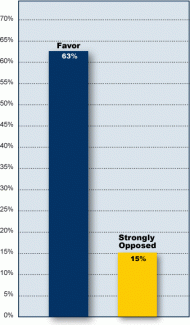
The reasons near cited for concern were fear of the unknown. People initially prefer traffic signals and end signs until they realize roundabouts allow them through the intersection safely without having to finish. Other concerns about rubber and possibly beingness confused about where to go also dissipate with use.

Roundabouts Move In What Direction,
Source: https://wsdot.wa.gov/travel/traffic-safety-methods/roundabouts
Posted by: williamsbrong1955.blogspot.com
0 Response to "Roundabouts Move In What Direction"
Post a Comment